
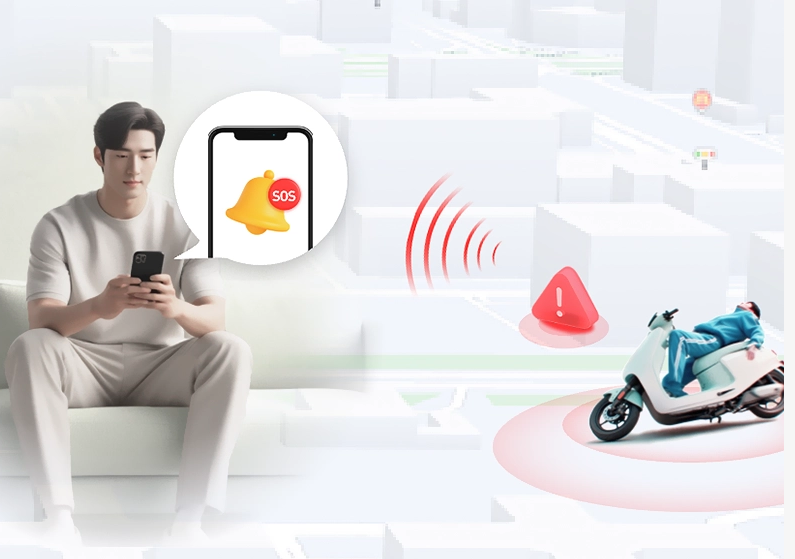
Connectivity has changed what riders expect from an electric two-wheeler. Beyond getting from one destination to another, customers may want location tracking, digital unlocking, movement alerts, and emergency notifications that help them stay informed during everyday journeys.
Dealers building a connected mobility range should recognize that a smart electric scooter is not simply a vehicle with an app—it combines hardware, software, communication services, and dependable after-sales support. LUYUAN operates in the electric two-wheeler sector, where the value of connected features depends as much on their practical operation as on the technology behind them.

Connected Features Need Clear, Practical Functions
Digital functions are most useful when they address recognizable customer concerns. GPS tracking can help riders locate a parked vehicle, while Bluetooth or NFC unlocking may reduce reliance on conventional keys. Movement alerts can notify an owner if a vehicle is moved unexpectedly, and electronic fencing can provide an alert when it crosses a configured boundary. Dealers evaluating a smart electric scooter should consider how easily customers can access these functions and understand their limitations, rather than counting the number of features listed in a catalogue.
Emergency alerts require particular care because riders may assume that an automatic message will always reach the right person. A system may detect a possible incident, retrieve vehicle location data, and send an SMS to preset contacts, but performance depends on the detection method, mobile network coverage, device permissions, and correct contact configuration. Buyers should ask what event triggers the alert, whether the rider can cancel a false alarm, and what happens if the vehicle is outside network coverage.
Privacy is another part of the connected experience. Location history, account details, and emergency-contact information should be handled through clearly explained permissions and data practices. Dealers need accessible guidance on account setup, contact management, location sharing, and user consent. If these details remain unclear, customers may avoid features that could otherwise be useful.
What Suppliers Should Explain Before an Order
A connected vehicle depends on more than the scooter itself. Its digital functions may involve an onboard control unit, GPS positioning, Bluetooth or NFC communication, a mobile application, and external network services. A prospective electric scooter company should be able to explain which functions are built into the vehicle, which depend on a phone or mobile network, and whether any service requires an additional subscription or regional activation.
Compatibility deserves attention before bulk purchasing. Application availability, language support, mobile operating-system requirements, and cellular network compatibility can vary across markets. A feature demonstrated successfully in one country may behave differently in another if network bands, service coverage, or software localization differ. Dealers should request a market-specific compatibility checklist and confirm whether app interfaces can be localized or require secondary development.
Technical documentation should also describe system behavior rather than relying on promotional language. Buyers can ask for installation and activation procedures, supported phone requirements, firmware update methods, known operating limits, and troubleshooting instructions. For emergency notification functions, written documentation should clarify the detection logic and message-delivery process. These details make it easier to explain the product accurately to retailers and end customers.
Evaluating LUYUAN’s Connected Mobility and After-Sales Support
LUYUAN’s connected mobility features include GPS positioning through BeiDou, GPS, and base-station methods, along with Bluetooth and NFC unlocking, electronic fencing, movement alerts, and app-based controls. Its intelligent riding functions also include options such as power modes, cruise control, hill descent control, and move assistance, depending on the vehicle configuration. For distributors reviewing this technology, the key questions concern availability on the specific model, regional compatibility, activation requirements, and the level of support available after delivery.
A supplier’s service capability becomes especially important once connected vehicles reach customers. Dealers should confirm how software issues are reported, which party handles application-related problems, whether replacement control units require configuration, and how warranty cases involving electronic components are assessed. A clear escalation path can reduce delays when the issue involves several systems rather than a single mechanical part.
Training materials matter just as much as technical assistance. Retail and service teams need straightforward instructions for pairing phones, setting emergency contacts, enabling location functions, checking permissions, and diagnosing common connection failures. A capable electric scooter company should provide documentation that helps partners explain both the benefits and the limitations of connected functions. Before committing to a larger order, dealers can test a sample vehicle and record setup time, alert delivery behavior, application stability, and the clarity of support responses.
Building a Reliable Connected Scooter Business
Connected technology can create additional value for a dealer, but it also adds responsibilities involving setup, privacy, network dependency, and customer education. A well-positioned smart electric scooter should offer functions that solve real problems without making their operation unnecessarily complicated. Buyers who evaluate these factors alongside vehicle quality and spare-parts availability are better equipped to judge whether a connected model suits their market.
The sourcing process should include practical demonstrations, written feature specifications, regional compatibility checks, and a clear service agreement. Emergency alerts deserve particular scrutiny because customers may rely on them during stressful situations; the system’s actual capabilities should be communicated without implying that every incident will be detected or every message delivered. Support arrangements should cover both vehicle hardware and the digital services that customers use after purchase.
With its connected functions and broader electric two-wheeler portfolio, LUYUAN participates in a market where digital usability is becoming part of the ownership experience. Dealers considering a smart electric scooter should assess how well its connected features work in their intended region and whether the supplier can support them throughout the vehicle’s service life. A dependable electric scooter company relationship rests on transparent specifications, practical training, responsive technical assistance, and realistic communication with customers.
