
Items assigned to chilled storage and items assigned to frozen storage ask different things of an appliance, even when their containers look alike. Two hypothetical storage lists can make that distinction visible: one contains items intended to remain chilled, and the other contains items intended to remain frozen.
A freezer vs refrigerator comparison begins with those required states. Available space, frequency of access and the arrangement of contents become meaningful only after the storage task has been identified.

Storage State Before Storage Arrangement
The required state divides the two lists by function. Refrigerated storage is described here in terms of conditions above freezing, while frozen storage requires conditions below freezing.
These are broad operating purposes, not prescribed settings for every appliance or item. The distinction explains why assigning an item to one list has practical consequences: its intended condition defines the kind of storage being sought.
A container’s size cannot determine which list it belongs on. Two equally sized containers might have different intended storage conditions, just as several differently sized containers might share one condition.
Grouping by size alone would hide that difference. The hypothetical lists therefore retain the chilled or frozen requirement beside each entry. Volume describes how much space the containers occupy; the required state describes what that space must provide.
The lists also separate uncertainty from a settled storage intention. An item whose required condition has not been established cannot be classified merely to balance the available space.
Its storage requirements need clarification before its place is assigned. This does not require inventing a universal storage period. The exercise concerns the condition sought, leaving item-specific guidance to information appropriate to the actual contents.
Reordering a list changes the description of daily use, not the condition assigned to its contents. A chilled group could be arranged around repeated retrieval or a recognizable shared use; frozen entries could be organized similarly.
These preferences concern where an entry appears within its own group. The chilled or frozen requirement stays attached to the entry throughout that reorganization, even if its position or neighbours change.
A shared organization scheme can therefore conceal a functional difference if the state labels are omitted. Both hypothetical lists could place items used together next to one another.
An observer would see the same grouping purpose, yet would still need the chilled or frozen annotation to understand each list’s storage task. In a freezer vs refrigerator comparison, the common pattern explains use; the annotations explain why the groups require different operating conditions.
The resulting explanation has two levels. First, each list identifies the storage condition needed. Second, its access pattern and grouping preferences describe use within that condition. A cabinet arrangement would eventually have to be examined against those preferences, but no shape is declared superior here.
The daily-use question is how contents could be located and retrieved while remaining assigned to the appropriate storage function. Even a convenient retrieval position still needs to belong to storage that meets the group’s required condition.
What Spare Space Can and Cannot Substitute
An empty part of a cabinet answers whether there might be room for additional contents, not whether those contents would receive the condition they require. An imagined owner may notice unused freezer space while the chilled-storage list needs more room.
Combining the two observations produces an attractive proposal: move the chilled group into the available space. The proposal still contains an unresolved assumption about operating purpose.
Whether a freezer can stand in for a refrigerator is the practical question raised in Homa Appliances‘ comparison. The question tests that assumption directly. If the available cabinet continues to operate for frozen storage, its empty volume does not supply the above-freezing condition sought by the chilled group. The difficulty lies in the mismatch between the intended task and the operating condition, even if every container physically fits.
Physical accommodation and functional accommodation therefore require separate answers. The first concerns room for the containers; the second concerns the storage state the appliance actually provides. A freezer vs refrigerator decision cannot merge them into a single judgement about space.
Evidence that the cabinet has an appropriate operating function would address the second question. An observation about unused volume addresses only the first. A hypothetical cabinet with ample room but the wrong operating purpose solves the fitting problem while leaving the storage problem unchanged.
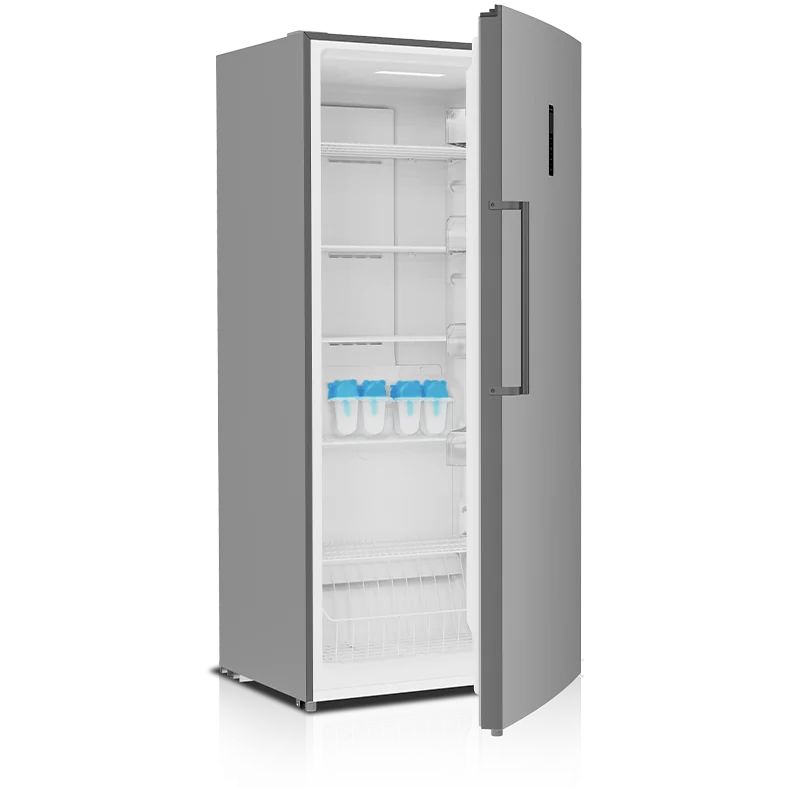
Homa Appliances’ FN1-77 provides a concrete example of this distinction. The upright model has a freezer-or-fridge conversion function, allowing the cabinet’s use to change between chilled and frozen storage.
Its 603-liter total net capacity provides a measurable starting point for assessing storage needs, while its dimensions of 190 cm in height, 83 cm in width and 75 cm in depth help buyers assess the available installation space. An installation check should also consider the manufacturer’s clearance requirements, rather than relying on external cabinet dimensions alone.
The model also combines electronic temperature control, Total No Frost, an external LED display and a door-open alarm. Conversion capability determines the storage function, capacity describes the available volume, and cabinet dimensions inform placement. The intended contents can then be matched to the selected operating mode rather than assigned on the basis of spare space alone.
