
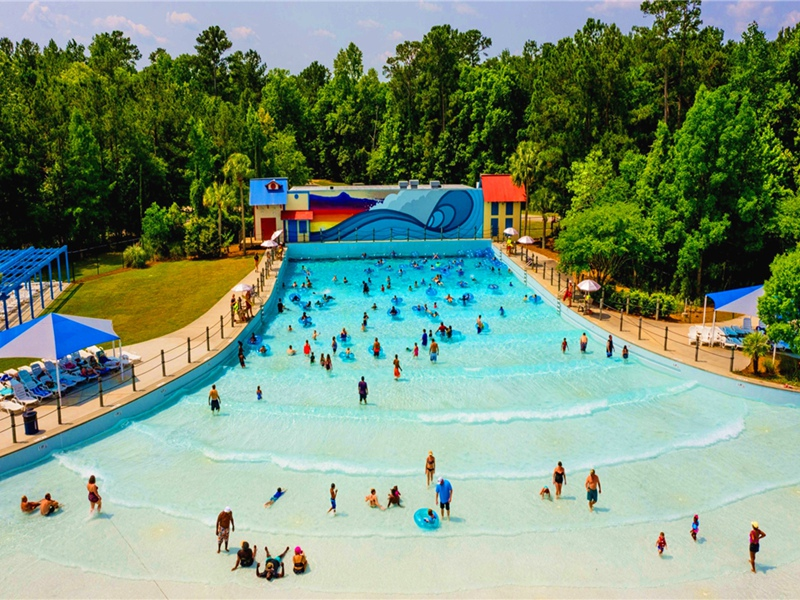
Wave generation changes how an entire pool is used, including the way people gather beside it and move towards other attractions. Asking ‘what is a wave pool’ begins with a basin in which equipment deliberately creates waves, then extends to the setting that makes that experience usable.
The planning errors around wave pools often occur between decisions: a selected wave format carries one assumption, the land allowance another and the circulation drawing a third. Five checks can expose those mismatches while the project still has room to resolve them.

- Treating Different Wave Systems as Interchangeable
Wave height helps define the proposed experience, but the generating method and intended venue belong in the same discussion. A specification for one pool concept cannot simply be carried across to another. The choice concerns the kind of attraction being developed before it concerns its dimensions.
Jinchao distinguishes artificial wave pools producing approximately 0.3–1 m waves from a separate vacuum system generating approximately 2–3 m waves. Their typical pool areas are 1,200–3,000 m² and 2,000–3,500 m² respectively, with project-specific sizing available. Each range needs to stay with its own system.
The vacuum arrangement removes air from an energy tank to create negative pressure. Opening a release valve lets atmospheric pressure push water back into the pool. Understanding that sequence gives the specification a physical meaning beyond the larger wave-height figure.
Wave height is not pool depth. The published height describes the generated wave, while the pool’s own dimensions belong to the project design. Substituting one measurement for the other would leave a different planning question unanswered.
- Allowing Land Only for the Water Area
A pool boundary leaves several uses outside its outline. Approaches, decks, technical space and guest facilities still need land. The available development area therefore has to accommodate a group of connected functions, even where the selected basin itself fits comfortably within the site.
On a master plan, ‘what is a wave pool’ becomes a question about the boundary of the allocation. The water area can be labelled separately from the space supporting it. Otherwise, two proposals may appear comparable while including different portions of the development.
The brief sent to a water park manufacturer can show these allocations as separate zones. A later change to the basin then has a visible consequence for neighbouring uses, rather than quietly consuming a path or service area already promised elsewhere.
- Drawing Circulation for the Quietest Moment
Movement around an attraction changes as people arrive, watch and leave. A route that looks generous beside an empty basin can become a meeting point for several flows. The planning task is to examine those coinciding movements, including approaches from lockers, dining and nearby rides.
Because wave pools can act as gathering attractions, their surroundings deserve an explicit circulation review. The drawing can follow people towards the pool and onwards to another activity, identifying where a stopping group occupies the same space as visitors passing through.
An entrance position also affects the next destination. Connecting the attraction to a main route involves more than adding an opening in a boundary. The connection needs to be examined with the adjacent attractions and facilities that will generate movement towards it.
The review can include an arrival from a nearby ride at the same time as a group leaves the pool. Following those journeys together tests the junction between attractions, rather than considering each route only as a single isolated connection.
- Confusing Pool Occupancy with Slide Throughput
People present in a pool and riders passing through a slide during an hour describe different things. Combining the figures without identifying their meaning can obscure how visitors are distributed. A busy gathering attraction may sit beside a ride that releases smaller groups at intervals.
Returning to ‘what is a wave pool’ clarifies why the comparison needs care: it is a place where participants remain within an activity area, not simply a route with a dispatch and exit. The operating brief needs to explain how those different patterns meet.
Discussion with a water park manufacturer can consider a high-capacity wave attraction alongside lower-capacity tube rides. That relationship informs the wider attraction mix. It does not establish a numerical pool capacity or guarantee that visitors will distribute themselves evenly throughout the site.
- Settling the Basin before the Wider Brief
A hotel amenity, a tourism resort and a municipal leisure project may assign different roles to a wave attraction. The intended audience, surrounding activities and visual setting influence the proposal. Those inputs need to be available while the pool concept is still being developed.
Jinchao’s layout discussions include the footprint, visitor groups, theme, adjacent slides and overall circulation. With the water park manufacturer, the client can review the complete brief. Agreement on the basin is more useful when the surrounding allocations and interfaces are recorded alongside it.
A hotel brief might prioritise connections with accommodation and other leisure spaces. A destination park may instead examine the attraction’s place among major rides. Recording that intended role gives the drawing review a purpose beyond achieving a particular water area.
The last planning check can follow a visitor from the wider park into the attraction and back out again. Every crossing passes through a decision about space, use or equipment. An unresolved connection marks the place where the proposal still needs coordination.
