
Electric vehicle battery assembly demands more than strong welds; every joint must meet defined electrical, mechanical, and dimensional requirements while fitting the pace of a tightly coordinated production line. Variations in material thickness, contact geometry, and heat generation can affect connection resistance or damage nearby components.
A capable resistance welding manufacturer approaches these challenges through application analysis, equipment configuration, and process validation rather than relying on a standard machine setup for every battery assembly.

Understanding the Welding Challenges in EV Battery Production
Battery manufacturing involves several joining tasks, from connecting conductive tabs and terminals to assembling structural components. Each application presents different requirements for electrical conductivity, mechanical strength, heat input, and dimensional accuracy. A process suitable for a structural bracket may not be appropriate for a thin electrical connection, particularly when sensitive materials are located close to the weld area.
Material selection plays a major role in process development. Copper and aluminum conduct heat and electricity differently from steel, while surface coatings and oxide layers can alter contact resistance. Engineers must consider these properties alongside workpiece thickness, electrode geometry, and clamping force to determine a suitable welding window.
Production volume introduces another layer of complexity. A battery line may contain multiple stations, automated handling systems, and inspection checkpoints, all of which influence cycle time and repeatability. Effective resistance welding solutions must accommodate these operating conditions while allowing engineers to identify and correct process deviations.
Customizing Equipment Around Battery Components
Customization begins with the joint specification rather than the equipment catalogue. Engineers typically review drawings, material grades, thickness combinations, access restrictions, target strength, and acceptable surface marks. These details help determine whether resistance spot welding, projection welding, or another joining process is appropriate for the component.
Electrode design and applied force require particular attention. Electrode shape affects current density and the contact area, while excessive or insufficient force can change heat generation and weld formation. Fixtures must also hold components in a repeatable position without obstructing electrode access or introducing unnecessary deformation.
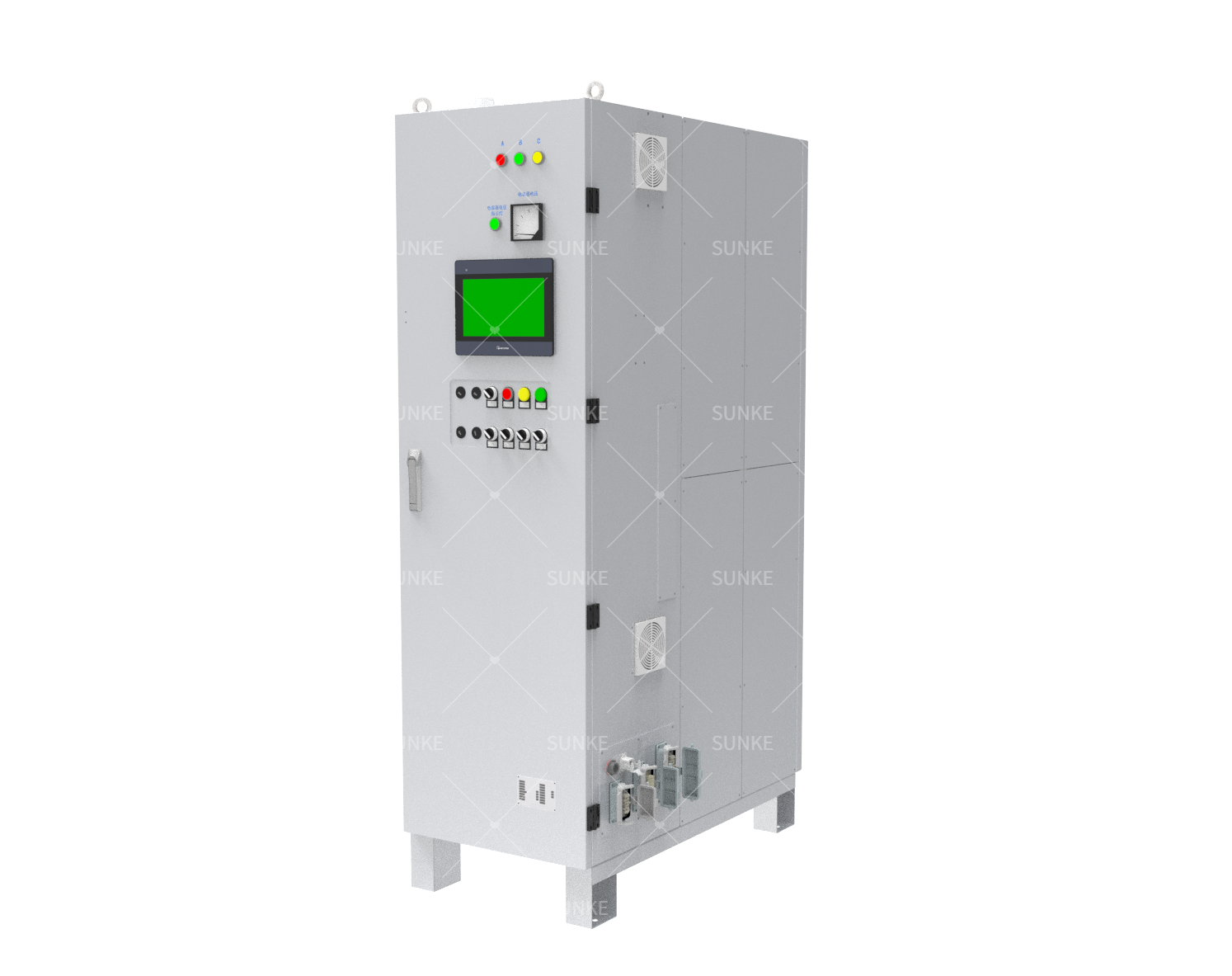
The electrical control system must match the application’s energy demands. For example, Sunke’s capacitor-discharge welder category offers selectable energy capacities of 10, 20, 30, and 40 kJ, with three-phase AC input rated at 110–480 V ±10%. Its water-cooled configuration and 10% duty cycle are relevant specification points, but suitability for a particular battery-line operation requires checking the exact model documentation and validating the proposed process experimentally.
When selecting a welding power and control configuration for battery components, engineers can refer to this comparison of MFDC, MFAC, and capacitor discharge welding controllers to better understand their operating characteristics and application differences.
Integrating Welding Controls With Automated Assembly
An automated station depends on coordinated communication between the welding equipment, fixtures, actuators, sensors, and line controller. The system must trigger the correct weld sequence, confirm component positioning, and respond appropriately when a fault occurs. Poor integration can disrupt production even if the welding parameters themselves are correctly configured.
Process monitoring helps engineers understand what happens during each welding cycle. Current, voltage, weld time, and electrode force can provide useful information about process variation, depending on the sensors and control functions available. Abnormal readings may indicate electrode wear, inconsistent surfaces, poor alignment, or changes in material condition.
For a resistance welding manufacturer, customization should also account for traceability and maintenance. Battery producers may need weld records associated with individual parts or production batches, while technicians need accessible fault information and clear procedures for replacing consumables. These requirements should be defined during system design instead of added after the line has been commissioned.
Validating Quality Before Full-Scale Production
A customized welding system should undergo application trials before deployment. Initial tests help establish suitable parameter ranges, after which representative samples can be evaluated against mechanical, electrical, and dimensional requirements. Depending on the joint design, validation may include tensile-shear testing, peel testing, resistance measurements, or metallographic examination.
Testing should cover realistic production variation rather than a single successful sample. Differences in material batches, surface conditions, electrode wear, and component positioning may influence the results. A documented process window gives production engineers a reference for identifying unacceptable deviations and deciding when revalidation is necessary.
The commercial evaluation should extend beyond the machine price. Commissioning time, integration work, operator training, spare-part availability, and after-sales support all affect the project’s operating cost. Manufacturers comparing resistance welding solutions should request clear information about customization boundaries, acceptance tests, documentation, and responsibility for resolving integration issues.
Conclusion
EV battery assembly requires welding processes that balance joint integrity, electrical performance, production speed, and protection of heat-sensitive components. Customization is most effective when it begins with the actual component requirements and continues through equipment integration, process trials, and production monitoring. A machine’s rated capacity alone cannot demonstrate that it will perform reliably in a particular battery application.
Sunke develops welding controllers, transformers, monitoring equipment, and customized welding systems, with in-house capabilities spanning circuit board production, equipment assembly, testing, and process verification. Its technical offering can be assessed against the specific joining requirements of an EV battery line, allowing manufacturing teams to evaluate equipment configuration, process control, and commissioning support before committing to full-scale production.
