
Cold feet do not always have a single cause. The toes are exposed to limited internal space and reduced movement during certain activities, while the sole remains in prolonged contact with cold ground and experiences repeated pressure with every step.
These different conditions create distinct demands on a shoe insulator, making its placement and surrounding construction just as important as the material itself. Y-Warm develops thermal insulation solutions for footwear and other functional applications, where the balance between warmth, flexibility, and moisture management influences the final design.

Two Heat-Loss Zones With Different Challenges
The toe box is particularly sensitive to changes in temperature because the toes have relatively little space and are positioned farthest from the ankle. In tight footwear, the toes may have limited room to move, while pressure from the upper can reduce the air space that helps maintain warmth. A bulky insulating layer may make this problem worse by reducing the available internal volume.
The sole faces another type of thermal challenge. During standing or walking, body weight compresses the footwear layers against the ground. This pressure can reduce the thickness of soft insulating components and change the amount of trapped air within them. Cold surfaces may also draw heat away through direct contact, especially when the footwear has a thin or highly conductive outsole.
These differences explain why one uniform insulation arrangement may not perform equally well throughout a shoe. The toe area needs sufficient coverage without restricting movement, whereas the sole requires insulation that can tolerate repeated compression. A well-designed shoe insulator system accounts for both conditions instead of treating the foot as a single thermal zone.
How Footwear Construction Changes Insulation Performance
The upper, lining, midsole, and outsole each influence heat transfer. Upper materials affect wind exposure and moisture exchange, while the lining provides the immediate interface with the foot. Beneath the foot, the insole and midsole contribute to cushioning and thermal resistance, and the outsole separates the shoe from the ground.
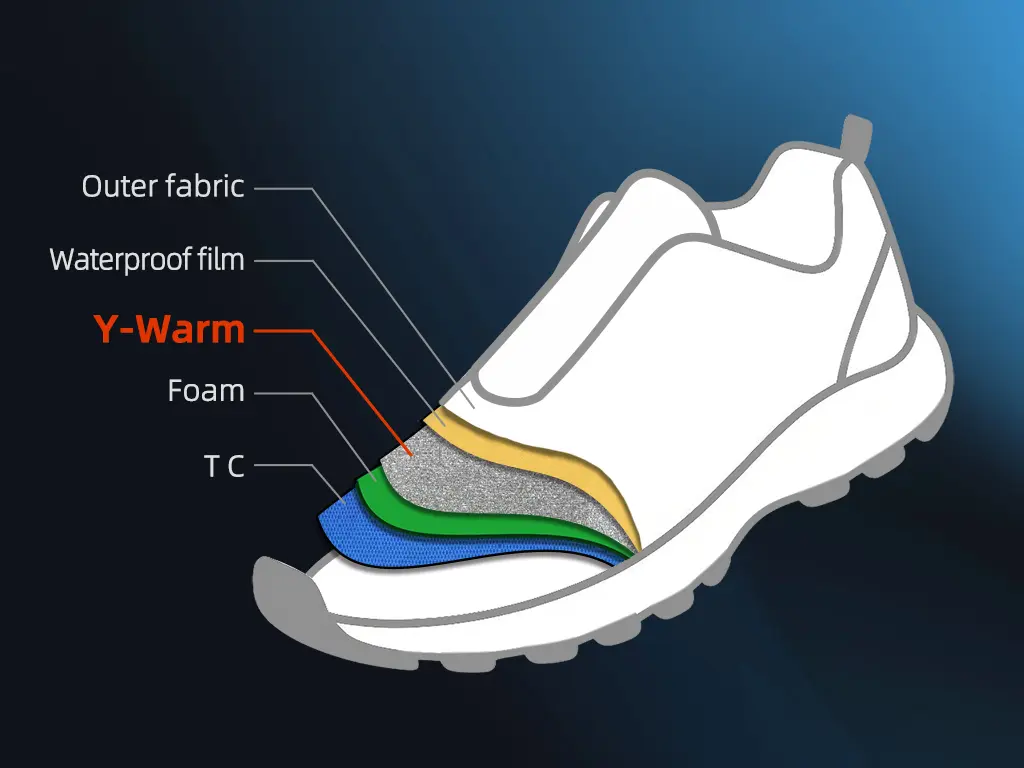
The order of these layers can change the behavior of the complete assembly. Depending on requirements for thermal insulation, water vapor permeability, and quick-drying performance, Y-Warm can be integrated into several footwear constructions. Examples include an upper material followed by Y-Warm and a lining, or an upper material combined with a waterproof membrane, Y-Warm, and a lining. Foam or fleece can also be incorporated into suitable designs.
Waterproof membranes introduce another consideration. They can limit external water penetration, but their vapor transmission characteristics affect how moisture generated by the foot moves outward. If moisture becomes trapped, damp linings may feel cold even when the insulation remains intact. The position of each layer should reflect the footwear’s expected exposure, activity level, and drying requirements.
Matching Insulation to Toe Movement and Sole Pressure
The toe box needs a balance between coverage and flexibility. Insulation that is too thick can press against the toes, restrict natural movement, and make the shoe uncomfortable during longer periods of wear. A thinner construction may preserve more internal space, provided its thermal performance is suitable for the intended conditions.
The sole requires a different assessment because compression occurs repeatedly throughout the footwear’s service life. A material that performs well before loading may lose some thickness under body weight. Compression recovery, fatigue resistance, and dimensional stability are useful properties to examine when selecting insulation for this area.
A practical design may use different material arrangements across the upper and lower sections of the shoe. For example, the toe box can prioritize low bulk and flexibility, while the footbed construction can place greater emphasis on resistance to compression. This zoned approach allows a shoe insulator to respond to the distinct mechanical and thermal demands of each area without unnecessarily increasing the overall shoe volume.
Testing Thermal Comfort Across the Whole Foot
Material testing should distinguish between heat loss through the upper and heat transfer through the sole. Measurements taken only beneath the foot may overlook cold spots near the toes, while upper-focused testing may not represent the effect of ground contact. Evaluating several locations provides a more useful picture of how warmth is distributed.
Footwear prototypes should also be tested under realistic conditions. Standing, walking, and repeated flexing create different pressure patterns, while changes in activity affect perspiration and internal humidity. Testing can examine temperature distribution, moisture accumulation, drying behavior, and comfort after repeated use. Different shoe sizes and foot shapes should be considered because internal fit influences both insulation thickness and air space.
The outsole and midsole deserve particular attention during durability assessment. Repeated loading can change their structure and affect the insulation positioned above them. A design that retains its thermal properties after compression and routine wear is more suitable for extended use than one evaluated only in its initial condition.
Conclusion
Footwear warmth depends on how effectively a design responds to different conditions around the foot. The toe box needs room for movement and sufficient protection from exposure, while the sole must resist heat transfer under continuous pressure.
Y-Warm develops thin thermal insulation materials that can be integrated into different footwear layer arrangements according to construction and performance requirements. Footwear manufacturers can discuss sample evaluations and suitable layer combinations with Y-Warm when developing insulation systems for specific shoe designs.
