
Within the diverse toolkit of industrial motion control, the stepper drive remains a cornerstone technology, prized for its unique blend of simplicity, precision, and cost-effectiveness. Acting as the intelligent intermediary between a controller and a stepper motor, a stepper drive translates command signals into precisely coordinated power pulses that drive motor motion. Modern advancements have transformed these devices from basic power amplifiers into sophisticated, networked control nodes. For OEMs and machine designers, understanding the multifaceted benefits of contemporary stepper driver module technology is essential for optimizing machine performance and economics. Manufacturers like Leadshine have been pivotal in this evolution, offering a comprehensive range of stepper drives that deliver significant advantages in system design, operational efficiency, and overall value, making them indispensable in countless automation applications from packaging to robotics.
Enhanced System Integration and Network Communication Capabilities
One of the most transformative benefits of modern stepper drives is their ability to seamlessly integrate into digital factory networks. Moving beyond traditional pulse-and-direction interfaces, today’s advanced stepper driver module units support real-time industrial Ethernet and fieldbus protocols such as EtherCAT and EtherNet/IP. This network integration, exemplified by Leadshine’s 2EM3E (EtherCAT) and 2EM3EIP (EtherNet/IP) Series, centralizes control and drastically simplifies wiring. A single cable can daisy-chain multiple drives, replacing a multitude of discrete pulse wiring. This architecture not only reduces installation time and cost but also enables sophisticated multi-axis synchronization and provides rich diagnostic data back to the master controller. The ability of a single stepper drive, like the dual-axis models from Leadshine, to control two independent motors via one network node further amplifies this benefit by halving the communication load and hardware footprint for two-axis applications. This level of integration is a key benefit that elevates system intelligence and scalability.
Space and Cost Optimization Through Hardware Consolidation

Physical panel space and component costs are perpetual constraints in machine design. Modern stepper drives deliver direct benefits in both areas. The trend toward miniaturization and multi-axis integration is a significant advantage. Leadshine’s dual-axis stepper driver module platforms, such as the 2EM3E Series, provide a compelling case. By housing the control electronics for two axes in one compact unit, they achieve at least a 50% saving in mounting panel space compared to two separate single-axis drives. This consolidation extends beyond space; it reduces the total number of components required—fewer drives, power supplies, and cables—which lowers the bill of materials, simplifies procurement, and reduces inventory complexity. For cost-sensitive projects or applications with dense control cabinets, this hardware optimization is a primary benefit of choosing an integrated stepper drive solution from a supplier like Leadshine.
Advanced Built-in Intelligence and Simplified Control Architecture
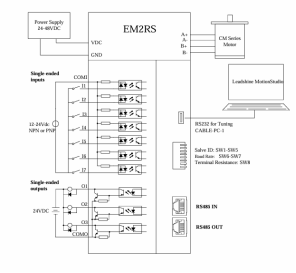
Contemporary stepper drives are embedded with significant onboard intelligence, which simplifies higher-level control systems and reduces development time. Many stepper driver module units now include features like programmable motion profiles and internal sequence storage. A prime example is Leadshine’s EM2RS Series, which features a built-in Position Register (PR) mode with a 16-segment motion table. This allows the drive to execute complex point-to-point sequences autonomously, triggered by simple digital inputs or network commands. This capability can often reduce the need for a dedicated motion controller or reduce the programming burden on a central PLC for many applications. This distributed intelligence is a major benefit, as it enhances system reliability by localizing control, accelerates machine commissioning, and provides a more scalable architecture. It allows machine builders to implement sophisticated motion sequences using a relatively simple and cost-effective stepper drive as the core control element.
Superior Motion Quality and Operational Reliability
The core function of a stepper drive is to move a motor smoothly and accurately. Advanced drives deliver substantial benefits in motion quality through refined microstepping technology and intelligent current control algorithms. These technologies break down each full motor step into hundreds of microsteps, resulting in exceptionally smooth, low-vibration motion. Leadshine consistently highlights “low noise and vibration, smooth motion” as a key feature across its drive series, from the EM3E to the CS3E. This smooth operation reduces audible noise, minimizes mechanical wear on belts and gears, and allows for higher precision at slow speeds. Furthermore, modern drives incorporate comprehensive protection circuits for over-voltage, over-current, and motor faults, safeguarding both the drive and the motor. This inherent robustness translates into higher machine uptime and longer service life, which are critical benefits for end-users operating production lines 24/7.
Application Versatility and Ease of Use
The versatility of the modern stepper drive is a profound benefit, allowing it to be deployed across an immense range of industries and applications. Leadshine’s product catalogs demonstrate this, noting excellent performance in diverse fields such as packaging, textile machinery, medical devices, 3C electronics, and robotics. This versatility stems from a wide array of available configurations—different voltage/current ratings, communication options, and form factors (like the compact stepper driver module designs). Additionally, ease of use is a key focus. Features like USB ports for quick parameter configuration, clear digital displays for status indication, and intuitive setup software significantly reduce the engineering expertise and time required to commission and maintain a system. For a global stepper drive supplier like Leadshine, providing products that are both powerful and user-friendly is a fundamental benefit that lowers the barrier to entry for implementing precise motion control.
Pathway to Closed-Loop Performance and Safety Integration
Finally, modern stepper drives offer a clear pathway to enhanced performance and safety. Many drive families, including those from Leadshine, have both open-loop and closed-loop variants within the same mechanical footprint. This allows designers to start with a standard stepper drive and later upgrade to a closed-loop version (like moving from the EM series to the CS series) for applications requiring guaranteed position verification, without redesigning the panel. Moreover, safety is no longer an afterthought. The availability of integrated safety functions, such as Safe Torque Off (STO) on drives like the 2EM3E series, is a critical benefit. It allows machine builders to meet stringent safety standards using a single, compact stepper driver module, simplifying safety system design and certification compared to using external safety relays.
In summary, the benefits of using today’s stepper drives are extensive and impactful. They provide critical advantages in system integration, space and cost savings, intelligent distributed control, motion quality, application versatility, and safety compliance. Through continuous innovation in products like their dual-axis EtherCAT drives, feature-rich EM2RS series, and compact EM3E modules, Leadshine exemplifies how a leading stepper drive manufacturer delivers these benefits. By leveraging these advanced stepper driver module technologies, machine builders and system integrators can develop equipment that is more efficient, reliable, and competitive, solidifying the stepper drive’s enduring role as a vital component in the automation ecosystem.
