
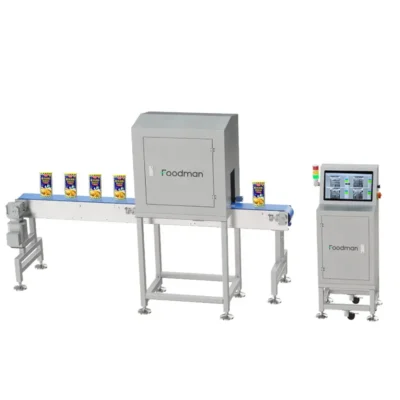
Selecting an inspection system is not simply a matter of finding a machine with a large detection range. Food manufacturers must match the inspection method to the product, package, line speed, contamination risks, and physical space available. A suitable food X-ray machine should fit the production process rather than force the process to fit the equipment.
Start With the Product, Not the Machine

Product characteristics determine much of the inspection design. First identify whether the line handles packaged goods, bulk materials, cans, bottles, pumped products, meat, seafood, dairy, snacks, or other foods. Foodman’s product range reflects these different formats, with dedicated systems for packaged products, bulk products, canned products, pumped products, and bone inspection.
Packaging also matters. Bags, boxes, rigid plastic containers, glass containers, and metal cans create different inspection conditions. Product dimensions determine the required tunnel or aperture size, so the opening should match the product rather than simply be as large as possible.
Match Detection Goals to Actual Risks
The next decision is what the inspection system must find. X-ray technology works through penetration and can identify metal and non-metallic, higher-density foreign objects. Depending on the product and system configuration, detectable contaminants can include glass, ceramic, stones, bones, hard plastics, and other dense materials.
Risk assessment should therefore come before model selection. A poultry processor concerned about residual bones may need bone inspection, while a snack producer selling bagged products may prioritize packaged-product inspection. Bulk rice, nuts, seeds, and coffee require a different material-handling arrangement from sealed retail packs.
Dual-energy capability can also matter for complex materials. Foodman describes dual-energy Time‑Delay Integration (TDI) detection as supporting analysis across complex materials and multilayer packaging, with applications including glass and bone detection. Such features should be evaluated against the actual contamination risks rather than treated as automatic requirements.
Check the Line Before Comparing Specifications
Map the production line before comparing machines. Measure product dimensions, conveyor height, installation space, product flow, and whether the system needs single- or multi-lane operation.
Throughput is another critical variable. A system needs to accommodate the required production speed without becoming a bottleneck. Different hardware configurations deliver different throughput performance. For reference, the packaged‑product model FXR‑4017 supports operating speeds of 10‑70 m/min, while bulk‑oriented FXR‑S6035 can reach 10‑100 m/min. These figures are model‑specific nominal values, and actual achievable speed will be subject to product characteristics and on‑site operating conditions. These examples illustrate why model selection should be based on the actual line rather than a generic speed claim.
Reject handling deserves equal attention. Depending on the equipment and application, rejection may involve a pusher, air blast, flipper, alarm, or line-stop function. The reject mechanism should suit product size, spacing, packaging, and acceptable product loss. A technically capable detector can still create operational problems if rejected products cannot be removed reliably.
Evaluate Hygiene and Operating Conditions
Food production exposes inspection equipment to demanding environments. Moisture, cleaning routines, temperature changes, and continuous operation can influence equipment suitability. Construction and ingress protection should therefore be checked against the production area.
For example, Foodman lists SUS304 stainless steel construction on several systems. The FXR-4017 specifies IP66 protection for the tunnel and IP54 for the remaining parts. Its stated operating range is -10°C to 40°C with 30%–90% humidity. These are model-specific figures, so buyers should verify the exact specifications of the system under consideration.
Maintenance access matters too. Operators should be able to clean relevant surfaces, inspect the reject system, and perform routine servicing without unnecessary production disruption.
Consider Data, Interfaces, and Verification
Modern inspection equipment should also be assessed as part of the wider production system. Foodman describes interfaces such as LAN and USB on selected models, while its inspection solutions include image recording, reporting, data storage, and batch tracking functions.
Before purchasing, define what information the quality team needs to record. Consider image retention, rejected-product records, and connections with existing plant systems.
Performance should also be verified with the actual product. Foodman offers product testing for uncertain buyers. Representative testing is valuable because results can depend on product composition, package structure, orientation, and operating conditions.
Turn the Selection Into a Production Decision
A practical shortlist should contain more than model names and headline specifications. Compare each candidate against five questions: Does the aperture fit the product? Can it meet required throughput? Does detection address the known risks? Can rejection work reliably? Can the equipment operate under plant conditions?
Foodman Vision supports this approach by focusing on production-specific equipment solutions rather than treating every food line as identical. The objective is not to choose the most feature-heavy food X-ray machine. It is to select a system whose inspection capability, mechanical configuration, data functions, and operating conditions match the production reality.
Make the Final Choice Through Testing
The right food X-ray machine is ultimately the one that performs reliably on the products and process it will actually inspect. Product type, package, aperture, line speed, contamination targets, reject method, hygiene conditions, and data requirements should all be verified before the purchase is finalized.
Manufacturers can use Foodman’s representative product testing and detailed line information to narrow the options, verify suitability, and avoid paying for configurations that do not address their actual inspection needs.
For B2B buyers, this creates a more defensible purchasing decision. Instead of relying on a specification sheet alone, the choice is tied to product characteristics, production constraints, and measurable inspection requirements.
